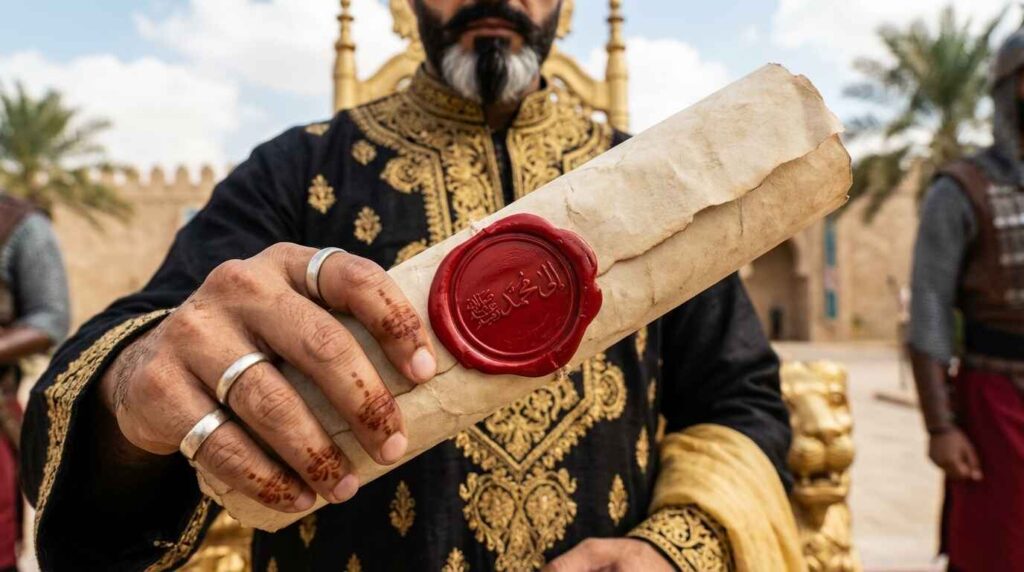

A Lesson in Justice, Humility, and the Power of Leading by Example
Important Note on Authenticity: This blog is based on the narration recorded in Al-Bidayah wal-Nihayah (Volume 11, Page 107) by the great Islamic historian Ibn Kathir (rahimahullah). The Arabic text of this narration has been preserved. The narrator chain (isnad) goes through Al-Sha’bi, a well-known and reliable Tabi’i scholar. Popular retellings sometimes change minor details, for example, calling the other man a “Jew” instead of a “Christian.” This blog uses the most authentic version from Ibn Kathir’s classical work. The item in dispute in the original narration is an armor (dir’), not a sword.
Introduction: A Story That Changed a Man’s Life
Imagine the most powerful ruler in the world. He commands a vast empire. Thousands of soldiers obey his every word. With one order, he could take anything he wanted. No one would dare stop him.
Now imagine this same ruler walking into a courtroom, as a regular citizen, to settle a dispute over a missing armor. And then, when he cannot produce enough witnesses, he quietly accepts the judge’s ruling against him, without anger, without using his power, without complaint.
This is the story of Hazrat Ali ibn Abi Talib (Radi Allahu Anhu), the fourth Caliph of Islam, and how his sense of justice was so extraordinary that it changed the heart of the man standing opposite him in court.
This is not just a history lesson. It is a lesson in what Islamic justice truly looks like, and why it moved a non-Muslim to enter the fold of Islam on the spot.
Part 1: Setting the Scene, Who Was Hazrat Ali (R.A.)?
Hazrat Ali ibn Abi Talib (R.A.) was the cousin and son-in-law of the Prophet Muhammad (Peace Be Upon Him). He was one of the earliest people to accept Islam, some scholars say he was the very first young man to embrace the faith. He was known for his extraordinary knowledge, his bravery in battle, and his deep love for justice.
After the martyrdom of Hazrat Uthman (R.A.), Hazrat Ali (R.A.) became the fourth Khalifah (Caliph) of the Muslim world around 35 AH (656 CE). His capital city was Kufa, in present-day Iraq. At that time, the Islamic state was one of the largest and most powerful in the world.
Despite being the supreme ruler, Hazrat Ali (R.A.) was famous for living a simple life and treating every person, Muslim, Christian, Jew, or otherwise, with complete fairness. He firmly believed that no one was above the law, not even the Caliph himself.

Part 2: The Incident, What Actually Happened
The Missing Armor
One day, Hazrat Ali (R.A.) noticed a man, a Christian, wearing an armor (dir’ in Arabic) that Ali (R.A.) recognized as his own. According to classical sources, this armor had fallen from Ali’s camel during the journey toward the Battle of Siffin and been picked up by this man.
Hazrat Ali (R.A.) went to the man and calmly told him: “This is my armor. I did not sell it, and I did not give it away.”
The man responded that the armor belonged to him. He did not call Hazrat Ali (R.A.) a liar, but he insisted the armor was his.
Going to Court, Not Using Power
Here is where the story takes its most remarkable turn. Hazrat Ali (R.A.) was the Amir-ul-Momineen, the Commander of the Faithful, the Caliph of the entire Muslim world. If he had wanted, he could have simply ordered soldiers to take the armor back. No one would have questioned him.
Instead, he took the matter to court. He brought the dispute before Qadi Shurayh ibn al-Harith al-Kindi, the appointed judge of Kufa, to be settled according to the law.
This single act, choosing justice over power, is what made this story so extraordinary that it was recorded by Islamic historians for over 1,400 years.
Inside the Courtroom
When the respected Qadi Shurayh saw the Caliph walking into his courtroom, he stood up out of respect. Hazrat Ali (R.A.) asked him to remain seated, he did not want any special treatment. He sat down beside his opponent, as equals in the eyes of the law.
Hazrat Ali (R.A.) presented his claim: “This is my armor. I did not sell it, and I did not give it away.”
Qadi Shurayh then turned to the Christian man and asked what he had to say. The man said the armor was his, but he openly acknowledged that he did not consider the Caliph to be a liar.
Now came the critical moment. Qadi Shurayh looked at Hazrat Ali (R.A.) and asked: “O Commander of the Faithful, do you have proof (bayyinah)?”
The Caliph Had No Witnesses
Hazrat Ali (R.A.) smiled and said: “Shurayh is correct. I do not have proof.”
There is a version of this narration where Hazrat Ali (R.A.) first attempted to call his sons Hasan and Hussain (R.A.) as witnesses. The judge acknowledged the noble status of these two, that they are among the leaders of the youth of Paradise, but still ruled that a son cannot testify in favor of his own father. This is a clear Islamic legal principle: even the most truthful witnesses cannot testify in cases where they have a personal interest (ta’assub).
With no qualifying witness available, Qadi Shurayh ruled in favor of the Christian man. The armor legally belonged to the man who held it.
The Caliph Accepts the Verdict, Quietly
Hazrat Ali (R.A.) did not get angry. He did not argue. He did not threaten to remove the judge. He did not remind anyone that he was the ruler of the entire Muslim world. He simply accepted the court’s decision, with dignity and peace.
This was the moment that broke the heart of the Christian man standing opposite him.
Part 3: The Man Could Not Walk Away
The Christian man picked up the armor and began to walk away. He had won the case. The law was on his side. He could have simply left.
But he couldn’t. He stopped, turned around, and came back.
He said, and these words are preserved in the classical historical text of Ibn Kathir: “As for me, I testify that this is the wisdom of the prophets. The Commander of the Faithful himself has taken me to his judge and the judge has ruled against him!”
Then he said: “I testify that there is no God but Allah, and Muhammad is the Messenger of Allah.”
Then he confessed the truth: “By Allah, the armor is yours, O Commander of the Faithful. I followed the army while you were on your way to Siffin, and the armor fell from your camel.”
Hazrat Ali (R.A.) replied with a generosity that matched his justice: “Since you have embraced Islam, the armor is yours as a gift.”

Part 4: Full References and Scholarly Sources
This story is not a legend or a Facebook post. It has clear, classical Islamic sources. Here is every reference you need, explained in plain language:
Primary Source #1, Al-Bidayah wal-Nihayah (The Beginning and the End)
Book: Al-Bidayah wal-Nihayah (البداية والنهاية) Author: Imam Ismail ibn Kathir (Ibn Kathir), died 774 AH / 1373 CE Volume and Page: Volume 11, Page 107 Chapter: Events of the Year 40 AH, A Mention of His Just Governance and Excellent Character Narrator: Al-Sha’bi (Amir ibn Sharahil al-Sha’bi), a highly reliable Tabi’i scholar Reliability: Al-Sha’bi is one of the most respected narrators among the Tabi’un (second generation after the Prophet). His narrations are widely accepted in Sunni Islamic scholarship.
About Ibn Kathir: Imam Ibn Kathir is one of the greatest historians and Quran commentators (mufassir) in Islamic history. His works include Tafsir ibn Kathir (the most widely read Quran commentary in the Sunni world) and Al-Bidayah wal-Nihayah (a 14-volume history of the world from an Islamic perspective). He was a student of the renowned scholar Imam Ibn Taymiyyah. His works are considered among the most authoritative in classical Islamic scholarship.
Primary Source #2, Sunehray Faislay (Golden Judgments), Darussalam Publishers
Book: Sunehray Faislay (سنہرے فیصلے), “Golden Judgments” Publisher: Darussalam Publishers (one of the most respected Islamic book publishers globally, based in Riyadh, Saudi Arabia, with offices worldwide) Content: A compiled collection of the famous judgments and decisions of Hazrat Ali (R.A.) and other Companions. This book is widely used in Islamic educational institutions. Languages Available: Arabic, Urdu, English
Supporting Source #3, Wikipedia Entry on Qadi Shurayh
Person: Shurayh ibn al-Harith ibn Qays al-Kindi (شريح ابن الحارث) Who was he: A Tabi’i (one who met the Companions of the Prophet but not the Prophet himself). He converted to Islam in Yemen during the lifetime of the Prophet (PBUH). He later moved to Kufa during the Caliphate of Abu Bakr (R.A.). Role: Served as the chief judge (Qadi) of Kufa for many decades, under Umar (R.A.), Uthman (R.A.), Ali (R.A.), and the Umayyad caliphs. He was famous for being completely impartial. Died: Around 80 AH / 697 CE. He reportedly lived over 100 years.
Qadi Shurayh is a key figure in this story. The fact that he ruled against the sitting Caliph Ali (R.A.) himself shows two things: (1) Islamic justice was truly blind and (2) Hazrat Ali (R.A.) appointed judges of the highest integrity, even if their rulings might go against him.
Supporting Source #4, Hiba Magazine (Translated Account)
Publication: Hiba Magazine, an Islamic lifestyle and education magazine based in Karachi, Pakistan Article: “Ali (R.A.) vs. a Jew”, Translated from Sunehray Faislay by Rana Rais Khan Note: This version adds more detail such as Hasan and Hussain being presented as witnesses. The popular version calling the man a ‘Jew’ may reflect a different variant narration; the original in Ibn Kathir says ‘Christian man’ (Nasrani).
Part 5: The Original Arabic Text
For those who want to verify this narration themselves, here is the original Arabic text as preserved in Al-Bidayah wal-Nihayah (11/107), reported by Al-Sha’bi:
عَنِ الشَّعْبِيِّ قَالَ وَجَدَ عَلِيُّ بْنُ أَبِي طَالِبٍ دِرْعَهُ عِنْدَ رَجُلٍ نَصْرَانِيٍّ فَأَقْبَلَ بِهِ إِلَى شُرَيْحٍ يُخَاصِمُهُ… فَضَحِكَ عَلِيٌّ وَقَالَ أَصَابَ شُرَيْحٌ مَا لِي بَيِّنَةٌ فَقَضَى بِهَا شُرَيْحٌ لِلنَّصْرَانِيِّ… أَمَّا أَنَا فَأَشْهَدُ أَنَّ هَذِهِ أَحْكَامُ الأَنْبِيَاءِ
Translation (key part): “Al-Sha’bi said: Ali ibn Abi Talib found his armor in the possession of a Christian man, and he brought the matter before Shurayh as a dispute… Ali laughed and said: ‘Shurayh is correct, I have no proof.’ So Shurayh ruled in favor of the Christian man… [The man came back and said:] ‘As for me, I testify that this is the ruling of the Prophets…'”
Part 6: The Islamic Legal Principles Behind the Story
To fully understand why this story is so remarkable, we need to understand four key Islamic principles that the story demonstrates:
1. Al-Bayyinah, The Burden of Proof
In Islamic law, the burden of proof lies with the person making the claim. The Prophet Muhammad (PBUH) stated: “Al-bayyinatu ‘ala al-mudda’i”, meaning the proof is the responsibility of the one who claims. (Recorded in Sunan Ibn Majah, Hadith No. 2321; also in Sunan al-Bayhaqi). This means that in a court of law, simply stating something, even if you are the Caliph, is not enough. You must have witnesses.
2. Shahadat, Rules of Testimony
Islamic jurisprudence does not allow a person to testify in favor of those with whom they have a close personal interest, such as a father or son. This prevents even well-meaning people from giving biased testimony. Qadi Shurayh applied this rule strictly, even when the witnesses being rejected were Hazrat Hasan and Hussain (R.A.), grandchildren of the Prophet. The law was the law for everyone.
3. Qada, The Independence of the Judiciary
One of the most important principles in Islamic governance is that the judiciary (the courts) must be completely independent from the political leadership. Hazrat Ali (R.A.) himself said to Qadi Shurayh: “You have sat in a place that only a prophet, or the successor of a prophet, or a man of great responsibility should occupy.” (Recorded in Al-Islam.org, Life of Ali ibn Abi Talib). This shows that Hazrat Ali (R.A.) deeply respected the role of judges and never tried to interfere in their decisions.
4. Adl, Justice for Non-Muslims Under Islamic Rule
The Quran commands: “O you who believe! Be upholders of justice, bearing witness for Allah alone, even against yourselves, your parents, or your relatives.” (Surah An-Nisa, 4:135). Islam requires that justice be given to all people, Muslim or not. The fact that Hazrat Ali (R.A.) went to the court for a dispute with a non-Muslim citizen, instead of using his political power, is a living example of this Quranic command.
Part 7: What Islamic Scholars Say About This Incident
This story has been mentioned, analyzed, and taught by scholars across the centuries. Here is what major scholars and books say:
Ibn Kathir (d. 774 AH): Recorded this incident in Al-Bidayah wal-Nihayah under the chapter of Hazrat Ali’s just governance (Volume 11, Page 107). He considered it as a prime example of Ali’s character as a ruler who upheld justice above his personal benefit.
Al-Sha’bi (narrator, d. ~103 AH): One of the greatest Tabi’in scholars. He was a jurist, a narrator of hadith, and a historian based in Kufa, the very city where this incident took place. His narrations are found in major hadith collections. Imam Ahmad ibn Hanbal and other great scholars considered him highly reliable.
Ibn Abd al-Barr (d. 463 AH): Mentioned the judgment of Ali (R.A.) with Qadi Shurayh as an example of how Islamic justice was applied equally to all.
Darussalam Publishers (Modern Scholars): In their compiled work Sunehray Faislay (Golden Judgments), this incident is presented as one of the most powerful examples of Islamic judicial ethics.
Part 8: How Authentic Is This Story? An Honest Assessment
Because the user has asked specifically about the authenticity rating of this narration, here is a clear and honest breakdown:
Classification: Athar (Historical Report) / Khabar
This narration is classified as an Athar (a report from the Companions or Tabi’in) rather than a Marfu’ Hadith (a hadith directly attributed to the Prophet). It is a historical report about what Hazrat Ali (R.A.) did, not a statement of the Prophet (PBUH). This is an important distinction in Islamic hadith science.
The Narrator Chain (Isnad)
The narration in Al-Bidayah wal-Nihayah goes through Al-Sha’bi. Al-Sha’bi is considered thiqa (reliable and trustworthy) by the major scholars of hadith criticism (rijal al-hadith). He was based in Kufa and lived during the era of the Tabi’in. While Ibn Kathir records this as a historical report (not with a formal rijal grading the way the Six Books of Hadith do), the chain is considered acceptable (maqbul) for historical narrations.
Note on Popular Versions
The most widely shared version of this story on social media and in popular talks calls the other party a ‘Jewish man’ and says the item was a ‘sword.’ However, the primary classical source (Ibn Kathir, Al-Bidayah wal-Nihayah 11/107) clearly states it was a ‘Christian man’ (رجل نصراني, rajul nasrani) and the item was an ‘armor’ (درع, dir’). Changing historical details, even in popular storytelling, is something Islamic scholars discourage, as it can lead to inaccuracies spreading over time. The core lesson of the story remains the same regardless of which version is cited.
Part 9: Five Powerful Lessons for Today
Lesson 1: Power Is Not a License to Do Whatever You Want
Hazrat Ali (R.A.) was the most powerful man in the Islamic world at that time. Yet he walked into a courtroom as a regular citizen. In today’s world, where powerful people regularly bypass the law, this example is a direct challenge. Real authority comes from living by the same rules you impose on others.
Lesson 2: The Law Must Be Blind to Status
Qadi Shurayh stood firm even when the claimant was his own boss, the Caliph. He did not change his ruling to please the powerful. This is the kind of judicial independence that Islam calls for, and which many modern legal systems still struggle to achieve.
Lesson 3: Actions Speak Louder Than Words
The Christian man was not converted by a speech, a debate, or an argument. He was converted by watching what Hazrat Ali (R.A.) did when he could have done anything. There was no force, no coercion, no propaganda. Just one man living by his principles, and another man watching, and being moved. This is the most powerful form of dawah (calling people to Islam).

Lesson 4: Accepting Defeat With Grace Is a Sign of Strength, Not Weakness
Losing in court was, for Hazrat Ali (R.A.), not a humiliation, it was a demonstration of faith. He believed in the justice system he had established. His calm acceptance of the ruling was a statement: “My system works, even when it works against me.” That kind of self-confidence in justice is rare, and it is unforgettable.
Lesson 5: Generosity Should Follow Justice
After the man embraced Islam and admitted the truth, Hazrat Ali (R.A.) did not say “I told you so” or demand the armor back. He gave it as a gift. Justice and generosity worked together. This combination, being firm in principle and generous in heart, is a hallmark of the Islamic character that the Quran and Sunnah call for.
Part 10: Quranic Verses and Hadith That Connect to This Story
Surah An-Nisa (4:135): “O you who believe! Be upholders of justice, bearing witness for the sake of Allah alone, even if it is against yourselves, your parents, or your relatives.”, This verse is the direct Quranic foundation for what Hazrat Ali (R.A.) demonstrated.
Surah Al-Ma’idah (5:8): “And do not let the hatred of others cause you to be unjust.”, This verse commands that justice must be given even to those who are enemies or strangers.
Hadith on Proof (Bayyinah): The Prophet (PBUH) said: “Al-bayyinatu ‘ala al-mudda’i, wal-yaminu ‘ala man ankara”, The proof is upon the claimant, and the oath is upon the one who denies. (Sunan Ibn Majah, Hadith 2321; Sunan al-Bayhaqi). This is exactly the principle Qadi Shurayh applied.
Hadith on Leadership and Accountability: The Prophet (PBUH) said: “Every one of you is a shepherd and every one of you is responsible for his flock.” (Sahih al-Bukhari, Hadith 893). Hazrat Ali (R.A.) understood this: as the shepherd of his flock, he could not exempt himself from the very laws he imposed on others.
Part 11: Who Was Qadi Shurayh?, The Brave Judge
Shurayh ibn al-Harith al-Kindi deserves his own place in this story. He served as the chief judge of Kufa for over 60 years, an almost unparalleled record. During his entire career, he was known for issuing judgments solely on the basis of the law, never on who the parties were.
What he did in this case, standing firm against the most powerful man in the Muslim world and ruling against him purely on the basis of the law, is one of the most powerful examples of judicial integrity in all of Islamic history.
His biography can be found in Siyar A’lam al-Nubala by Imam al-Dhahabi (Volume 4, Pages 100-105), another highly respected classical work of Islamic biography.
Conclusion: Justice That Changes Hearts
The story of Hazrat Ali (R.A.) and the armor is more than a historical event. It is a living proof of what Islam looks like when it is practiced with complete sincerity.
A man saw a ruler walk into a courtroom. He saw that ruler lose the case. He saw that ruler accept the verdict without flinching. And in that moment, when no sermon was preached, no argument was made, no force was used, a man’s heart was changed forever.
The Christian man said it perfectly: “I testify that this is the wisdom of the prophets.”
This is the Islam that Hazrat Ali (R.A.) practiced. This is the Islam that Qadi Shurayh defended from the bench. This is the Islam that the Quran commands: justice for everyone, at all times, no matter who is in front of you.
May Allah (SWT) give us all the wisdom to live by these principles, not just to admire them from a distance.
آمِيْن يَا رَبَّ الْعَالَمِيْن
Quick Reference Summary
| Item | Details |
| Primary Source | Al-Bidayah wal-Nihayah, Volume 11, Page 107, Ibn Kathir |
| Narrator | Al-Sha’bi (Amir ibn Sharahil), Reliable Tabi’i scholar |
| Author (Ibn Kathir) | Imam Ismail ibn Kathir, died 774 AH / 1373 CE |
| Supporting Book | Sunehray Faislay, Darussalam Publishers |
| Who was the judge? | Qadi Shurayh ibn al-Harith al-Kindi, Chief Judge of Kufa |
| Other party in the case | A Christian man (Nasrani), confirmed in Ibn Kathir |
| Item in dispute | Armor (dir’), not a sword, per the original narration |
| Time period | During the Caliphate of Hazrat Ali (R.A.), approx. 36-40 AH |
| Legal principle applied | Al-Bayyinah ‘ala al-Mudda’i, Proof is on the claimant |
| Quranic support | Surah An-Nisa 4:135, Be upholders of justice |
| Hadith support | Sunan Ibn Majah 2321, Burden of proof rule |