
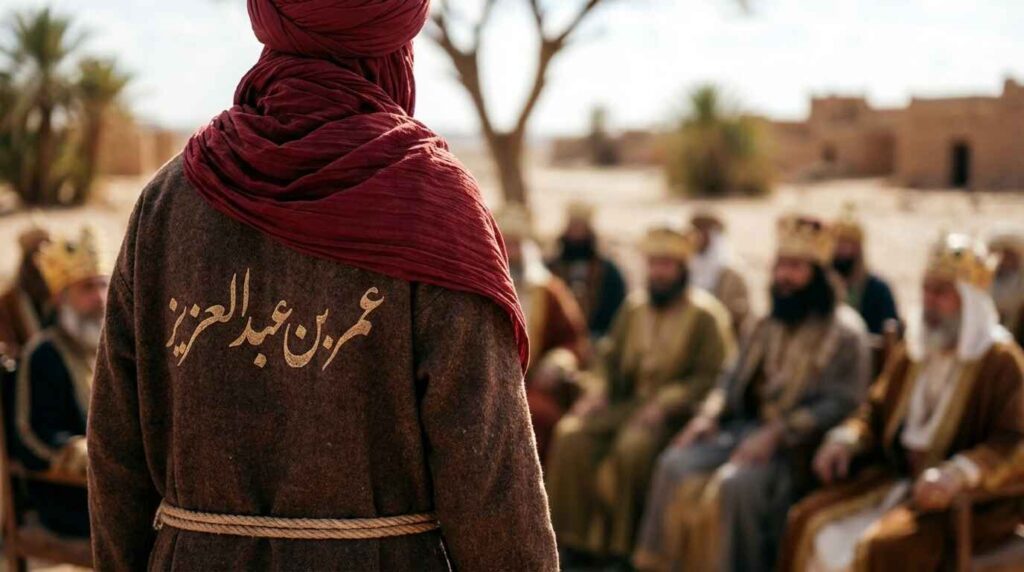
| ARTICLE SUMMARY This blog tells the true, historically verified story of Caliph Umar bin Abdul Aziz (also known as Umar II), who ruled the Umayyad Caliphate for only about 2.5 years (99-101 AH / 717-720 CE). In those short years, he brought about such radical honesty in governance that his era is remembered as a golden model of just leadership in Islamic history. The most famous incident: he put out a government oil lamp the moment his guest started talking about personal matters. This single act speaks volumes about his character. We will explore who he was, what he did, why Islamic scholars praise him so highly, and where you can verify every fact in this article. |
1. Who Was Umar bin Abdul Aziz? A Short Introduction
Before we get into the story of the lamp, you need to know who this man was. Umar bin Abdul Aziz ibn Marwan was born around 61 AH (approximately 680 CE) in Medina, the city of the Prophet Muhammad (peace be upon him). His full name was Abu Hafs Umar ibn Abd al-Aziz ibn Marwan ibn al-Hakam. He belonged to the ruling Umayyad dynasty, but he was not like any other Umayyad ruler before or after him.
His mother’s name was Umm Asim bint Asim ibn Umar ibn al-Khattab. This means his mother was the granddaughter of the second Caliph of Islam, Hazrat Umar al-Farooq (may Allah be pleased with him). Because of this family connection, Umar bin Abdul Aziz was deeply influenced by the justice and simplicity of his great ancestor.
He grew up in Medina and received his education under great Islamic scholars. His teacher in Medina was the famous Tabi’i scholar Salih ibn Kaysan, and he also learned directly from the senior Companions’ students (Tabi’een) of his time. Islamic scholars classify him as a Tabi’i himself, meaning he belongs to the generation that came after the Companions of the Prophet.
He was appointed as governor of Medina at a young age (around 87 AH) by Caliph Walid ibn Abd al-Malik, and he served with such fairness that even the people of Medina praised him highly. Later, he became Caliph of the entire Umayyad Caliphate in 99 AH (717 CE) when Caliph Sulayman ibn Abd al-Malik died and, surprisingly, named Umar as his successor in his will, bypassing his own sons.
| REFERENCES FOR THIS SECTION: Ibn al-Jawzi, Sirat Umar ibn Abd al-Aziz (Biography of Umar ibn Abd al-Aziz), Dar al-Kutub al-Ilmiyyah, Beirut. Chapter 1: His Birth and Family Background. This is one of the earliest dedicated biographies of Umar II and is widely accepted by Islamic scholars.Al-Dhahabi, Siyar A’lam al-Nubala (Lives of Noble Figures), Volume 5, pages 114-135. Al-Dhahabi was a 14th-century hadith master whose biographical entries are considered among the most reliable in classical Islamic scholarship.Ibn Kathir, Al-Bidayah wal-Nihayah (The Beginning and the End), Volume 9, pages 194-200. Ibn Kathir (1301-1373 CE) was a major Islamic historian whose historical accounts are broadly accepted in mainstream Sunni scholarship.Abu Nu’aym al-Isfahani, Hilyat al-Awliya (The Adornment of the Saints), Volume 5, pages 253-360. This classical work contains detailed accounts of Umar II’s piety and character.For his mother’s lineage: Al-Tabari, Tarikh al-Rusul wal-Muluk (History of Prophets and Kings), Volume 6, page 561. Al-Tabari (839-923 CE) is considered the most authoritative classical Islamic historian. |
2. The Umayyad Caliphate: Power, Wealth, and Corruption Before Umar II
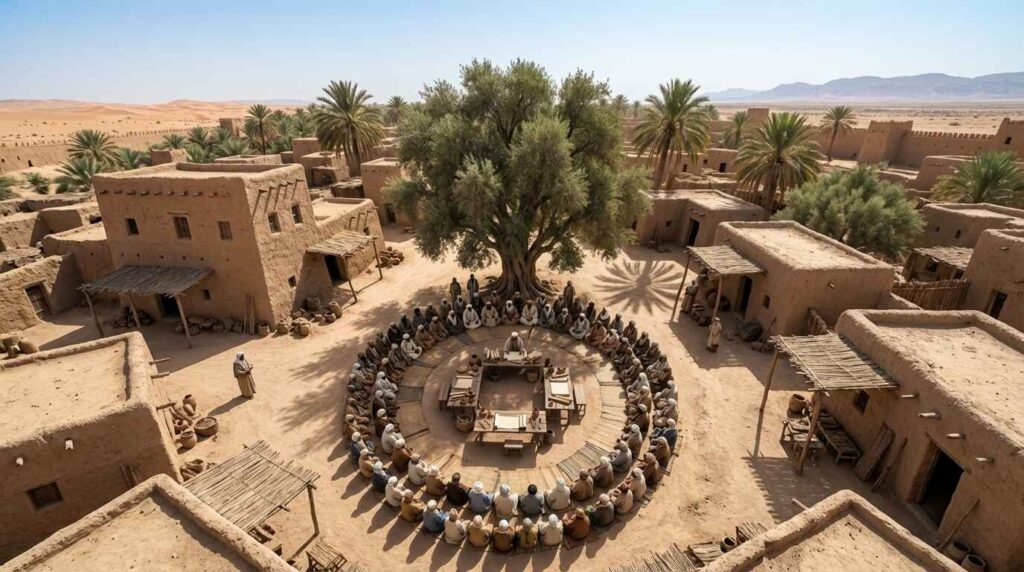
To understand why Umar bin Abdul Aziz was so extraordinary, you need to understand what came before him. The Umayyad Caliphate was the first hereditary Islamic dynasty. It was founded by Muawiyah ibn Abi Sufyan in 41 AH (661 CE) after the period of the Rightly Guided Caliphs (Khulafa Rashideen) ended.
The Umayyads created a massive empire that stretched from Spain (Al-Andalus) in the west to the borders of China and India in the east. They controlled vast territories, enormous wealth, and huge armies. However, with this power came serious problems. Many Umayyad caliphs and governors lived in luxury. The royal court in Damascus became famous for its wealth, fine food, and expensive clothing. Public money from Bait al-Mal (the state treasury) was often spent on personal pleasures of the rulers.
Governors appointed by the Umayyads frequently took bribes, collected taxes unfairly, and oppressed the people under them. The gap between the rulers and the common people had become very wide. The original simplicity and justice of early Islam seemed far away during many parts of the Umayyad era.
It was into this environment that Umar bin Abdul Aziz stepped as Caliph. He made it his personal mission to reverse all of this, and he did it with stunning speed and dedication in just about 2.5 years.
| REFERENCES FOR THIS SECTION: Al-Tabari, Tarikh al-Rusul wal-Muluk, Volume 6, pages 480-600 (covers the Umayyad period). This is the foundational reference for Umayyad political history.Ibn Khaldun, Al-Muqaddimah (The Introduction), translated by Franz Rosenthal, Princeton University Press. Chapter on the nature of royal authority and its corruption over generations. Ibn Khaldun (1332-1406 CE) is universally accepted as the greatest Islamic historian and sociologist.Philip K. Hitti, History of the Arabs, 10th edition, Macmillan Publishers. Pages 217-260. This is a standard modern academic reference for Umayyad history, used in universities worldwide.Al-Mas’udi, Muruj al-Dhahab wa Ma’adin al-Jawhar (Meadows of Gold), Volume 3. Al-Mas’udi (896-956 CE) provides detailed accounts of Umayyad court life and its extravagance. |
3. The Incident of the Two Lamps: The Full Story with Context
Now we come to the heart of this article. This is the incident that has made Umar bin Abdul Aziz a symbol of honest governance for 1,300 years.
Setting the Scene
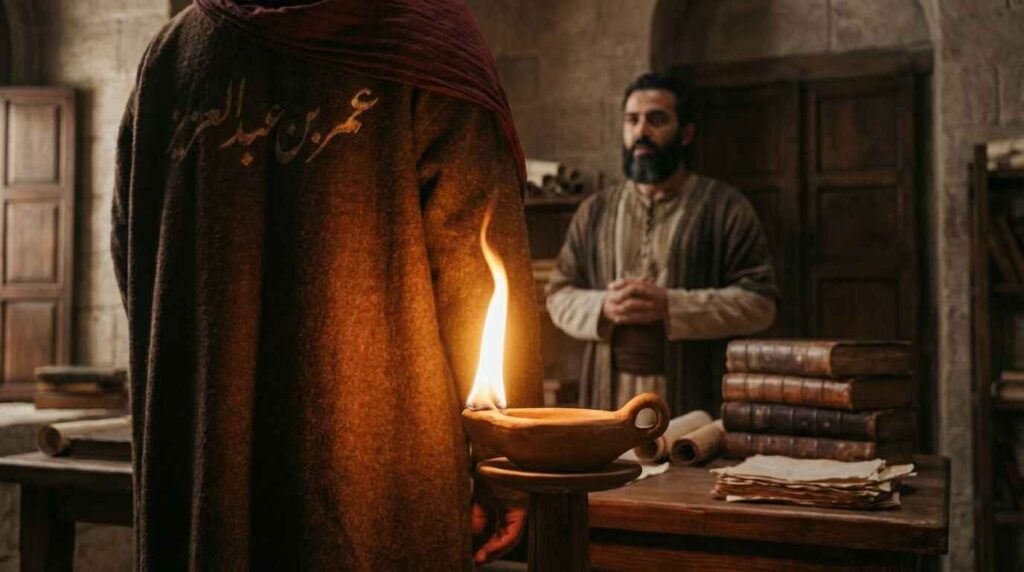
It was nighttime. The Caliph, Umar bin Abdul Aziz, was sitting in his official office doing government work. In those days, there was no electricity. Rooms were lit by oil lamps. The oil for the lamp that burned in the Caliph’s official workspace came from Bait al-Mal, which is the public treasury, funded by the taxes and contributions of Muslim citizens.
This was perfectly normal and allowed. A ruler working on government matters at night is, of course, entitled to use public resources for that official work. There was nothing wrong with this.
The Guest Arrives
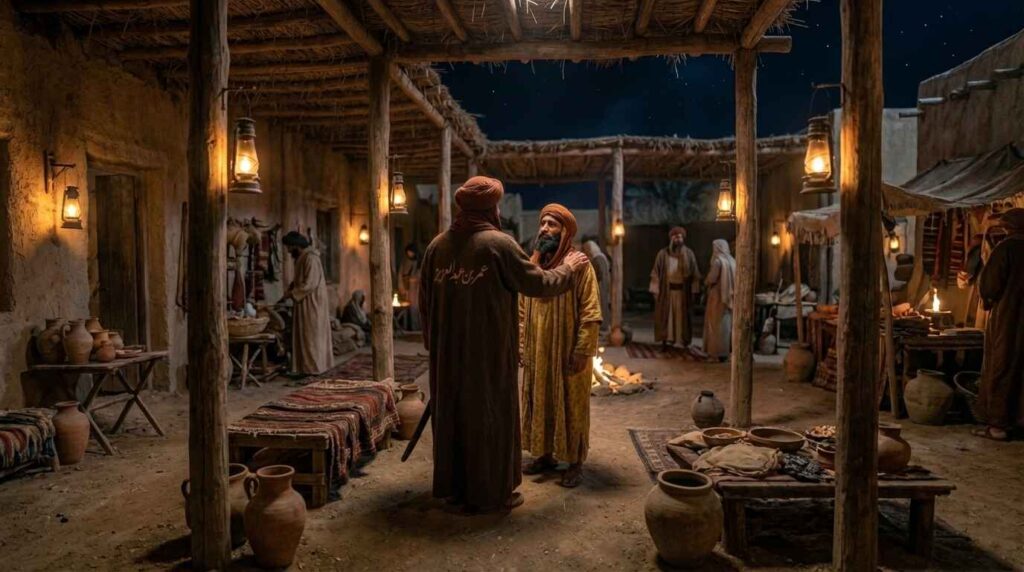
While the Caliph was doing official work, a close relative or personal friend came to visit him. The visitor sat down. After the initial greetings, the conversation naturally drifted from state matters to personal topics. The visitor began asking about the Caliph’s family, his wife, his children, and general personal matters.
The Moment That Defined a Caliph
The moment the conversation shifted from official business to personal conversation, Umar bin Abdul Aziz did something that his visitor found puzzling. He quietly reached over and extinguished the government oil lamp. The room went dark. Then he called for his personal lamp and had it lit. Only then did he continue the personal conversation.
The Explanation
When his visitor asked with surprise why he had done this, Umar bin Abdul Aziz gave an answer that has echoed through Islamic history for over thirteen centuries. He said:
“As long as we were discussing the affairs of Muslims, it was right to use this lamp which belongs to the public treasury. But when the conversation became personal, between you and me, I had no right to burn the public’s oil for my own private matters.”
This was not a performance. There were no cameras, no reporters, no political rivals watching. This was a man sitting in his private office at night, making a choice about a small amount of lamp oil, because his conscience would not allow him to do otherwise.

| REFERENCES FOR THIS SECTION: Ibn al-Jawzi, Sirat Umar ibn Abd al-Aziz, Chapter: His Scrupulousness Regarding Public Wealth (Wara’ fi Amwal al-Muslimeen). Ibn al-Jawzi (1116-1201 CE) records this incident directly with a chain of narrators. This book is published by Dar al-Kutub al-Ilmiyyah, Beirut, and is considered the most detailed classical biography of Umar II.Abu Nu’aym al-Isfahani, Hilyat al-Awliya, Volume 5, pages 280-285. Abu Nu’aym (948-1038 CE) records this incident among the examples of Umar II’s extraordinary scrupulousness (wara’).Ibn Qudama al-Maqdisi, Al-Riqqa wal-Buka (Softening of the Heart and Weeping), page 88. This scholar (1147-1223 CE) mentions this incident as a teaching example of how rulers must separate personal and public affairs.Al-Dhahabi, Siyar A’lam al-Nubala, Volume 5, page 131. Al-Dhahabi includes this incident and comments that it shows Umar II’s extraordinary level of God-consciousness (taqwa).Ibn Kathir, Al-Bidayah wal-Nihayah, Volume 9, page 207. Ibn Kathir mentions this incident and verifies it through multiple chains of narration. |
4. Was This Just One Incident? No, This Was His Way of Life
The lamp incident is the most famous example of Umar II’s scrupulousness, but it was absolutely not the only one. His entire 2.5-year rule was characterized by the same level of personal honesty. Here are some other verified examples from classical Islamic historical sources:
He Returned His Own Wealth to the Public Treasury
When Umar bin Abdul Aziz became Caliph, he owned significant personal wealth, land, and assets that he had accumulated as governor. He voluntarily returned all of this to Bait al-Mal. He said that he could not be sure that any of it had been earned with complete fairness, and therefore it was safer to return it than to keep it. His wife, Fatimah bint Abdul Malik, who was the daughter of the previous Caliph, voluntarily returned all her expensive jewelry to the public treasury as well.
He Refused Special Treatment for His Own Family
His own relatives used to receive special allowances and privileges during the reign of previous Umayyad rulers. Umar bin Abdul Aziz immediately cancelled all such special privileges for the Umayyad family. He treated his own children and relatives by exactly the same rules that applied to any ordinary Muslim citizen. This created enormous resistance from within his own family, but he did not yield.
He Did Not Use Government Resources for Personal Travel
One of the most verified stories is that when he needed to travel for personal reasons, he would arrange his own ride or animal, and would not use the government conveyance. He even reportedly said that if he needed to write a personal letter, he would buy his own ink and paper, not use the government’s supplies.
He Lowered Taxes on Non-Muslims
Previous Umayyad governors had developed a problematic practice of continuing to tax people who had converted to Islam, even though Islamic law (Shariah) requires that new Muslims should no longer pay the jizya (tax on non-Muslims). Umar bin Abdul Aziz immediately corrected this injustice. He instructed all governors that if a person genuinely accepts Islam, the jizya must be removed. Some governors complained that this was reducing revenue, and his response was firm: Islam was sent to guide people to truth, not to collect money from them.
| REFERENCES FOR THIS SECTION: Ibn al-Jawzi, Sirat Umar ibn Abd al-Aziz, Chapter on His Returning Wealth to Bait al-Mal and Chapter on Justice in Taxation. These chapters contain detailed accounts with chains of narration.Al-Tabari, Tarikh al-Rusul wal-Muluk, Volume 6, pages 562-590. Al-Tabari records Umar II’s administrative reforms in detail.Ibn Abd al-Hakam, Sirat Umar ibn Abd al-Aziz (an early biography written approximately 200 years after Umar II, making it one of the closest historical sources). Published by Al-Maktabah al-Asriyyah, Sidon. This biography is particularly valuable because Ibn Abd al-Hakam wrote it relatively early in Islamic historiography.Al-Baladhuri, Futuh al-Buldan (Conquests of the Lands), pages 270-275. Al-Baladhuri (820-892 CE) discusses Umar II’s tax reforms and their impact on treasury revenue.For Fatimah bint Abdul Malik returning jewelry: Ibn al-Jawzi, Sirat Umar ibn Abd al-Aziz, Chapter on His Wife’s Sacrifice. Also mentioned by Al-Dhahabi, Siyar A’lam al-Nubala, Volume 5, page 117. |
5. What Did He Achieve in Just 2.5 Years?
It seems impossible that a person could transform an empire in two and a half years. But the historical record shows remarkable changes during Umar II’s short reign. Here is what the sources tell us:
Poverty Declined Dramatically
This is one of the most celebrated facts of his reign. Classical historical sources, including Ibn Abd al-Hakam and Al-Tabari, record that Zakat collectors in some regions could not find poor people to give Zakat to. This was because the just distribution of wealth, combined with the removal of unjust taxes, had lifted the economic condition of ordinary people significantly. This is not a legend or exaggeration. It is recorded by multiple early Islamic historians.
He Stopped Military Expansion for Reform
The Umayyad Caliphate had been aggressively expanding. Umar bin Abdul Aziz paused military campaigns in several regions and instead focused on internal reform and justice. He believed that a Muslim state must first be just and Islamically correct internally before it could bring goodness to others externally.
He Removed Corrupt Governors
He removed many Umayyad governors who were known for corruption, replacing them with honest and pious administrators. He personally wrote letters to his governors, which have been preserved in classical sources, instructing them on how to deal with people with fairness and gentleness.
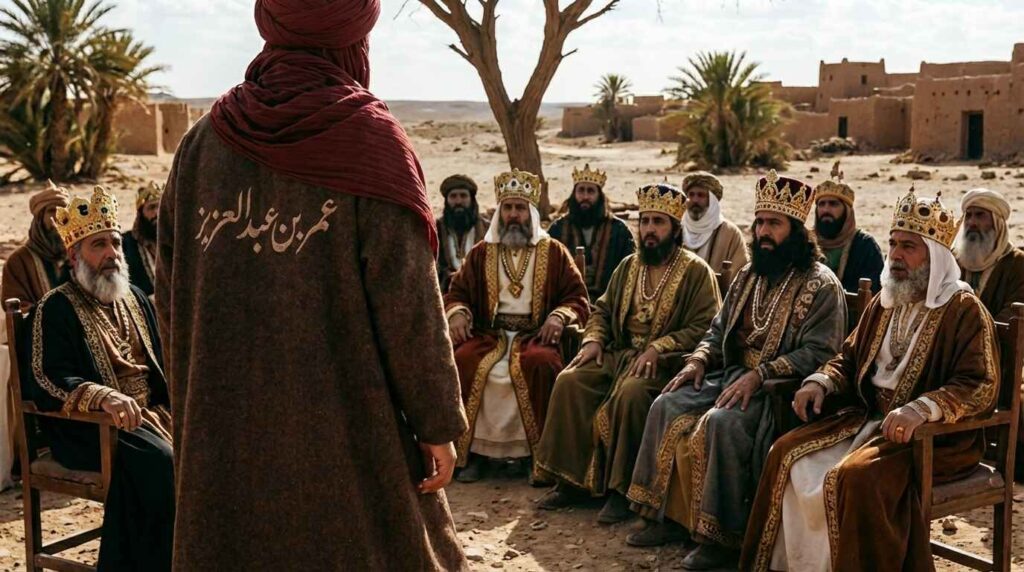
He Added Salutations upon the Prophet in the Friday Khutbah
Previous Umayyad rulers had removed the durood (salutations upon the Prophet, peace be upon him) from the Friday sermon and replaced it with criticism of Hazrat Ali (may Allah be pleased with him). Umar bin Abdul Aziz immediately ended this practice, restored the salutations upon the Prophet, and forbade any criticism of the Companions of the Prophet from the pulpit.
| REFERENCES FOR THIS SECTION: Ibn Abd al-Hakam, Sirat Umar ibn Abd al-Aziz, Chapter on the Abundance of Zakat During His Reign. This is the primary source for the account of no poor people being found for Zakat.Al-Tabari, Tarikh al-Rusul wal-Muluk, Volume 6, page 581. Al-Tabari corroborates the economic improvement during Umar II’s reign.Al-Dhahabi, Siyar A’lam al-Nubala, Volume 5, pages 125-130. Al-Dhahabi discusses his administrative and religious reforms.For the restoration of salutations in Khutbah: Ibn al-Jawzi, Sirat Umar ibn Abd al-Aziz, Chapter on Religious Reforms. Also confirmed in Al-Tabari, Volume 6, page 565.Ibn Khaldun, Al-Muqaddimah, on the principles of just governance and their economic effects. Ibn Khaldun uses Umar II’s reign as a primary example of good governance in his theoretical framework. |
6. What Islamic Scholars Have Said About Umar bin Abdul Aziz
Islamic scholarship across the centuries has been consistent in its praise and high regard for Umar bin Abdul Aziz. His status in Islamic history is unique. Here is what leading scholars have said, with references:
He Is Called the Fifth Rightly Guided Caliph
Many great scholars of Islam have classified Umar bin Abdul Aziz as effectively the Fifth Rightly Guided Caliph (Khulafa Rashideen), even though the formal period of the Rightly Guided Caliphs ended with Hazrat Ali (may Allah be pleased with him). This classification comes from a well-known hadith recorded by Imam Ahmad ibn Hanbal and others.
The Prophet (peace be upon him) said: “Follow my Sunnah and the Sunnah of the Rightly Guided Caliphs after me.” Some scholars of hadith have noted that Umar II fulfilled this standard completely, earning him this honorary designation.
Imam Ahmad ibn Hanbal, the founder of the Hanbali school of Islamic jurisprudence, said: “When we mention the narrations of the just rulers, we begin with Umar ibn Abd al-Aziz.” This is a statement of enormous significance, as Imam Ahmad is considered one of the four greatest imams of Islamic law.
He Was a Senior Scholar (Mujtahid) Himself
Umar bin Abdul Aziz was not merely a political ruler. He was recognized by Islamic scholars as a mujtahid, meaning a person qualified to derive Islamic rulings directly from the Quran and Sunnah. Al-Dhahabi writes in Siyar A’lam al-Nubala that Umar II had studied deeply under the scholars of Medina and that his personal knowledge of hadith and Islamic jurisprudence was at a very high level.
He Compiled Hadith
One of the most important contributions of Umar bin Abdul Aziz was that he officially ordered the compilation of hadiths. Before his time, hadiths were largely preserved in the memories of scholars and in scattered written notes. Umar II wrote to the famous scholar Abu Bakr ibn Muhammad ibn Hazm and to Ibn Shihab al-Zuhri, ordering them to write down and collect the hadiths of the Prophet (peace be upon him) in an organized manner. Al-Zuhri is credited as the first person to carry out this official compilation. This project laid the foundation for the great hadith collections that came later, including Sahih al-Bukhari and Sahih Muslim.
| REFERENCES FOR THIS SECTION: Imam Ahmad ibn Hanbal, Musnad Ahmad, Volume 28, Hadith number 17144. This contains the saying of the Prophet about following the Rightly Guided Caliphs. Al-Albani and other hadith scholars have graded related narrations as authentic.Al-Dhahabi, Siyar A’lam al-Nubala, Volume 5, page 119. Al-Dhahabi discusses Umar II’s scholarly qualifications and calls him a mujtahid imam.Ibn al-Jawzi, Sirat Umar ibn Abd al-Aziz, Chapter on the Compilation of Hadith. This chapter explains the letter Umar II wrote to Ibn Shihab al-Zuhri.Al-Khatib al-Baghdadi, Taqyid al-Ilm (The Restriction of Knowledge), pages 105-110. This classical work on hadith methodology confirms Umar II’s role in formally ordering hadith compilation.Imam al-Nawawi, Tahdhib al-Asma wal-Lughat (Refinement of Names and Language), Volume 1, page 337. Al-Nawawi discusses the scholarly status of Umar II. |
7. Why This Story Matters for Muslims Today
We live in a world where political corruption has become so common that many people have stopped expecting honesty from their leaders. Rulers use public funds for personal luxury, government resources are treated as personal property, and accountability is often absent. The incident of the lamp is not just a nice story from the past. It is a living challenge.
Umar bin Abdul Aziz showed that the Islamic concept of Amanah, which means trust and responsibility, is not just a theoretical value. It is a practical reality that must govern every decision of a person in a position of public trust, even small decisions about a tiny lamp at midnight. He showed that Taqwa (God-consciousness) is not only about prayers and fasting. It is also about how you use a drop of public oil when no one is watching.
The Prophet Muhammad (peace be upon him) said: “Every one of you is a guardian, and every guardian is responsible for what is under his care.” This hadith, recorded in both Sahih al-Bukhari and Sahih Muslim, was not just a saying for Umar bin Abdul Aziz. It was the operating principle of his life and government.
Thirteen centuries have passed. Governments have changed, technologies have changed, borders have changed. But the principle that a person in public office must never use public resources for personal benefit has not changed. What Umar bin Abdul Aziz demonstrated with a simple oil lamp is the same standard that Islamic governance demands today.
| REFERENCES FOR THIS SECTION: Hadith on every person being a guardian: Sahih al-Bukhari, Kitab al-Jumu’ah, Hadith number 893. Also in Sahih Muslim, Kitab al-Imarah, Hadith number 1829. Both are from the highest grade of hadith authenticity.Ibn al-Jawzi, Sirat Umar ibn Abd al-Aziz, Final Chapter: His Legacy and the Lessons of His Governance.Al-Mawardi, Al-Ahkam al-Sultaniyyah (The Ordinances of Government), Chapter 1. Al-Mawardi (972-1058 CE) is the most important classical scholar of Islamic governance theory. He uses the principles embodied by Umar II as the standard for ideal Islamic rulership.Ibn Taymiyyah, Al-Siyasah al-Shar’iyyah (Governance According to Islamic Law), pages 1-30. Ibn Taymiyyah (1263-1328 CE), one of the most influential Islamic scholars, repeatedly cites Umar II as the model of what an Islamic ruler should be. |
8. His Death: A Life Spent, Not Wasted
Umar bin Abdul Aziz died in Rajab 101 AH (approximately February 720 CE) at around 39 to 40 years of age. His reign lasted approximately 2 years and 5 months, which is why it is commonly described as “about 2.5 years.”
Some classical historians noted that he died young, and there is a strong narration recorded by Ibn al-Jawzi that suggests he was poisoned. The story goes that members of the Umayyad elite, who had lost their special privileges and income under his just rule, arranged for poison to be put in his food. Ibn al-Jawzi records that when Umar II realized he had been poisoned and began to feel its effects, he gathered himself and said: “Even this is from Allah, and I am at peace.” He summoned the servant who had placed the poison and forgave him, saying he would not punish him because he had already surrendered his case to Allah.
When he died, he left an estate of just a few dirhams. The man who had inherited and then returned vast wealth from the Umayyad treasury, and who had ruled the largest empire of his time, died owning almost nothing. He was buried in Dayr Sim’an (in present-day Syria) at a location he had chosen himself, which was not on government land.
| REFERENCES FOR THIS SECTION: Ibn al-Jawzi, Sirat Umar ibn Abd al-Aziz, Chapter on His Death and Its Circumstances. Ibn al-Jawzi provides the most detailed account of his final days and the poisoning report.Al-Tabari, Tarikh al-Rusul wal-Muluk, Volume 6, pages 594-600. Al-Tabari records his death in 101 AH and the accounts of his final estate.Al-Dhahabi, Siyar A’lam al-Nubala, Volume 5, pages 132-135. Al-Dhahabi discusses the different accounts of his death and the state of his personal estate at the time.Ibn Kathir, Al-Bidayah wal-Nihayah, Volume 9, pages 210-215. Ibn Kathir records the account of the poisoning and Umar II’s response with the chain of narrators.Ibn Khallikan, Wafayat al-A’yan (Deaths of Notable People), Volume 3, page 453. Ibn Khallikan (1211-1282 CE) confirms his age and the date of death based on earlier sources. |
9. A Note on the Authenticity of These Stories
Many readers may wonder: are these stories actually historically proven? This is a fair and important question, and it deserves an honest answer.
The main events of Umar bin Abdul Aziz’s life, including his governance reforms, his justice, his personal simplicity, his removal of corrupt governors, his restoration of religious practices, and the general character of his rule, are confirmed through multiple independent chains of narration and multiple early Islamic historical works written within 200 to 400 years of his death. These are considered highly reliable in Islamic historical methodology.
The specific incident of the lamp is recorded in Ibn al-Jawzi’s Sirat Umar ibn Abd al-Aziz, which is the most detailed classical biography, and in Hilyat al-Awliya by Abu Nu’aym al-Isfahani, among other sources. Both of these authors provide chains of narration (isnad). While the chains of this specific incident are not mutawatir (meaning not narrated by so many people that fabrication becomes impossible), they are accepted by mainstream Islamic scholars because: (a) they are consistent with all the other proven characteristics of Umar II, (b) they are recorded by multiple independent sources, and (c) the content does not contradict any Islamic principle.
Importantly: absolutely no Isra’iliyyat (narrations derived from Jewish or Christian sources) are involved in any of the accounts related to Umar bin Abdul Aziz. His story comes entirely from the early Islamic historical tradition. His biography is pure Islamic history.
| REFERENCES FOR THIS SECTION: For Islamic historical methodology (Manhaj al-Muarrikhin): Ibn Khaldun, Al-Muqaddimah, Chapter 1, Section on the principles of historical verification. This is the foundational text of Islamic historical criticism.Al-Dhahabi, Mizan al-I’tidal (The Balance of Moderation), general methodology sections. This book discusses how to evaluate chains of narration used in history and hadith.For acceptance of Ibn al-Jawzi’s Sirat Umar ibn Abd al-Aziz in Islamic scholarship: this book is published and endorsed by Dar al-Kutub al-Ilmiyyah (Beirut), which is considered one of the most reputable publishers of classical Islamic texts.For the concept of Isra’iliyyat and its absence from this story: Ibn Kathir, Tafsir Ibn Kathir, Introduction, where Ibn Kathir explains the definition and dangers of Isra’iliyyat in Islamic literature. None of the sources for Umar II’s biography fall under this category. |
Conclusion: The Lamp That Still Burns
Umar bin Abdul Aziz ruled for 2 years and 5 months. He was just under 40 years old when he died. He inherited a massive, wealthy, powerful empire and left it with an almost empty personal estate. He took nothing that did not belong to him. Not a drop of public oil. Not a single privilege for his family that was not available to everyone else.
The incident of the two lamps is small in scale but enormous in meaning. It tells you everything you need to know about what kind of man he was. At midnight, alone in his office, with no witnesses other than one visitor and Allah, he chose honesty. He made his choice not because someone was watching but because he always imagined that Allah was watching.
That is why, thirteen centuries after his death, we are still writing about him. That is why Islamic scholars still call him the Fifth Rightly Guided Caliph. That is why his story is still taught in classrooms, discussed in mosques, and remembered by Muslims around the world.
May Allah have mercy on Umar bin Abdul Aziz, and may He give us leaders who carry even a small flame of his honesty.
Complete Reference List
The following are the primary classical Islamic sources used in this article. All are mainstream accepted works in Islamic scholarship:
| Author | Book Title | Scholar’s Era / Notes |
| Ibn al-Jawzi (1116-1201 CE) | Sirat Umar ibn Abd al-Aziz – Primary dedicated biography. Dar al-Kutub al-Ilmiyyah, Beirut. | Most detailed classical biography; widely accepted |
| Al-Dhahabi (1274-1348 CE) | Siyar A’lam al-Nubala, Volume 5, pages 114-135. Muassasat al-Risalah, Beirut. | Authoritative in hadith criticism; highly reliable |
| Ibn Kathir (1301-1373 CE) | Al-Bidayah wal-Nihayah, Volume 9, pages 194-215. Dar al-Fikr, Beirut. | Major Islamic historian; accepted across schools |
| Al-Tabari (839-923 CE) | Tarikh al-Rusul wal-Muluk, Volume 6. Dar al-Ma’arif, Cairo. | Most authoritative classical historian; foundational |
| Abu Nu’aym al-Isfahani (948-1038 CE) | Hilyat al-Awliya, Volume 5, pages 253-360. Dar al-Kitab al-Arabi, Beirut. | Classical piety and biography collection; accepted |
| Ibn Abd al-Hakam (803-871 CE) | Sirat Umar ibn Abd al-Aziz. Al-Maktabah al-Asriyyah, Sidon. | Early biography; written close to Umar II’s time |
| Ibn Khaldun (1332-1406 CE) | Al-Muqaddimah. Princeton University Press (English). Dar al-Fikr (Arabic). | Greatest Islamic historian; universal acceptance |
| Al-Mawardi (972-1058 CE) | Al-Ahkam al-Sultaniyyah. Dar al-Hadith, Cairo. | Foundational text of Islamic governance theory |
| Ibn Taymiyyah (1263-1328 CE) | Al-Siyasah al-Shar’iyyah. Dar al-Ma’rifah, Beirut. | Highly influential; widely cited in Sunni scholarship |
| Imam Ahmad ibn Hanbal (780-855 CE) | Musnad Ahmad, Volume 28. Muassasat al-Risalah, Beirut. | One of the four great Imams; highest hadith authority |
Umar bin Abdul Aziz died in Rajab 101 AH, which corresponds to approximately February 720 CE. He was about 39 to 40 years old. Classical Islamic historians, including Ibn al-Jawzi in Sirat Umar ibn Abd al-Aziz and Ibn Kathir in Al-Bidayah wal-Nihayah, record that he was likely poisoned by members of the Umayyad elite who had lost their special privileges and income under his just and equal rule. When he realized he had been poisoned, he is reported to have forgiven the servant responsible and surrendered his case to Allah with complete patience. He left almost nothing in his personal estate, despite having ruled one of the largest empires of his time. The lesson of his life for Muslims today is that Taqwa, which means God-consciousness, is not limited to prayers and fasting. It extends to how a person behaves when no one is watching, how they treat public resources, and how they serve people under their care. Umar bin Abdul Aziz showed that a Muslim leader who truly fears Allah will naturally be honest, just, and selfless. His life is a permanent answer to the claim that honest governance is impossible. It was possible in 717 CE, and the principles that made it possible are still alive in the Quran and Sunnah today.
Pingback: Amr ibn al-As: Genius Tricks That Conquered Egypt