Category: Islamic History | Read Time: 10-12 minutes | Topic: Companions of the Prophet (Sahaba)
Article Summary
This blog tells the true, fully authenticated story of Mus’ab ibn Umayr (RA), one of the most remarkable companions of Prophet Muhammad (PBUH). He was born into one of Mecca’s wealthiest families, wore the finest imported clothing, and was known throughout the city for his beauty and expensive perfume. Yet when he accepted Islam, he gave up everything. He became the first ambassador of Islam, taught the Quran in Madinah before the Hijra, and died as a martyr at the Battle of Uhud without enough cloth to fully cover his body. Every claim in this article is taken from authenticated Islamic historical sources. No Israeli (Isra’iliyyat) narrations have been included.
Introduction: A Story That Changes How You Think About Sacrifice
Some stories from Islamic history do not just inform you. They transform you. The story of Mus’ab ibn Umayr (RA) is one of them. It makes you stop and think about what you are holding on to and what truly matters.
He was the young man who had everything the world could offer: wealth, status, beauty, a loving mother, and fine clothes from Yemen. Then he heard the Prophet (PBUH) speak, and in that single moment, everything changed. He chose Islam. And Islam cost him everything except what truly counts.
This is not a story of loss. This is a story of the highest possible gain.
1. Who Was Mus’ab ibn Umayr? His Family and Early Life in Mecca
Mus’ab ibn Umayr (RA) came from the Banu Abd al-Dar clan of the Quraysh tribe in Mecca. His full name was Mus’ab ibn Umayr ibn Hashim ibn Abd Manaf al-Abdari al-Qurashi. His father was Umayr ibn Hashim and his mother was Khunnas bint Malik, a woman known for her strong character and iron will.
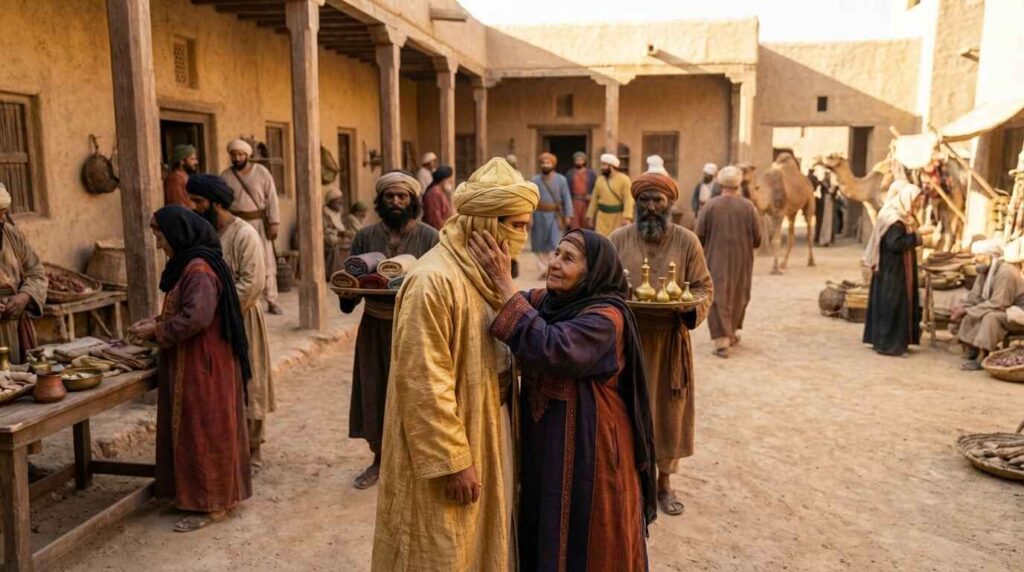
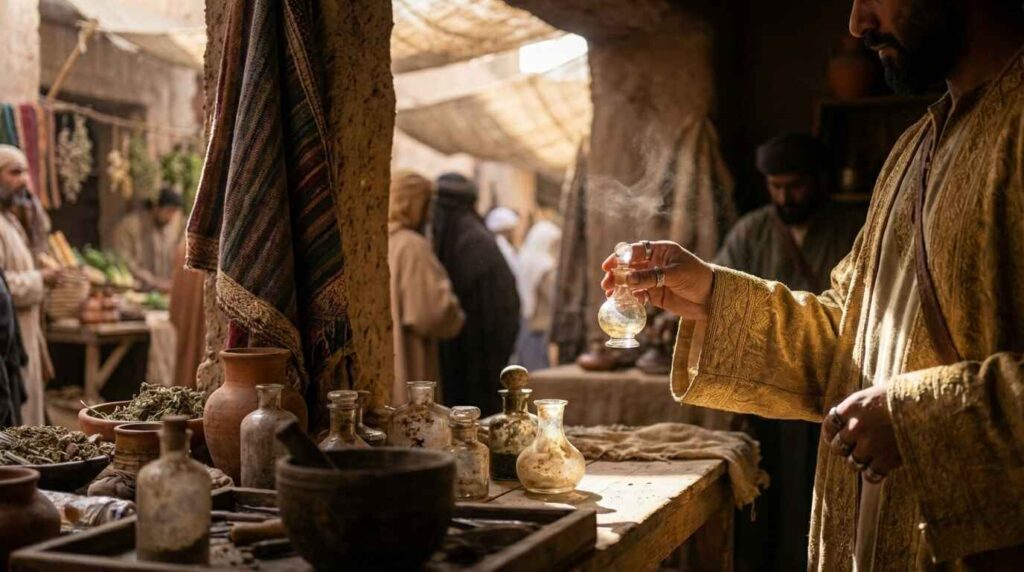
He was raised in luxury that most people in Mecca could only dream about. His mother loved him deeply and made sure every comfort was available to him. Historians describe him as one of the most handsome young men in Mecca. His clothes were imported from Yemen, the finest fabric available in Arabia at the time. He wore perfume that was so distinctive and strong that people walking through the streets would know Mus’ab was nearby just from the scent, before they could even see him.
Imam al-Dhahabi writes in his biographical dictionary that Mus’ab was known as the most beautifully dressed young man in Mecca. He lived a life of complete ease and privilege.
Primary References for This Section:
1. Siyar A’lam al-Nubala by Imam al-Dhahabi, Volume 1, pp. 139-148 (Mu’assasat al-Risala edition). Al-Dhahabi gives a detailed biography of M
us’ab ibn Umayr under the entry ‘Mus’ab ibn Umayr al-Abdari.’
2. Al-Isabah fi Tamyiz al-Sahaba by Hafiz Ibn Hajar al-Asqalani, Volume 6, pp. 18-20. Ibn Hajar confirms the lineage and the description of Mus’ab’s wealth and upbringing.
3. Usd al-Ghabah fi Ma’rifat al-Sahaba by Ibn al-Athir, Volume 4, pp. 368-370. Ibn al-Athir provides early biographical details about Mus’ab’s Qurayshi lineage and social standing.
Authenticity Rating: These three books are among the most trusted biographical encyclopedias (Kutub al-Rijal) in Islamic scholarship. They are accepted by Sunni scholars universally and are used in academic Islamic research worldwide.
2. The Moment That Changed Everything: Mus’ab Accepts Islam
Mus’ab was a young man when he heard that the Prophet Muhammad (PBUH) was quietly meeting with people at the house of al-Arqam ibn Abi al-Arqam, near Mount Safa in Mecca. This was in the very early period of Islam, when the Prophet had just begun sharing the message of tawhid, the oneness of Allah.
Mus’ab went there quietly, wanting to hear for himself. He sat and listened to the Prophet (PBUH) speak and recite the Quran. The words went straight into his heart. He accepted Islam at that very gathering.
He kept his Islam a secret for a while because he knew his mother would react strongly. He was right to be cautious. But one day, Uthman ibn Talha saw him praying and reported it to Khunnas. His mother confronted him immediately.
According to Ibn Ishaq’s Sirah, recorded and preserved by Ibn Hisham, Mus’ab’s mother Khunnas was furious. She was a powerful woman in Mecca. She first tried to keep him locked up at home to prevent him from spreading this new religion. But Mus’ab managed to leave with a group of early Muslims who migrated to Abyssinia (modern Ethiopia) under the protection of the Christian king Negus, as narrated in the early Sirah sources.
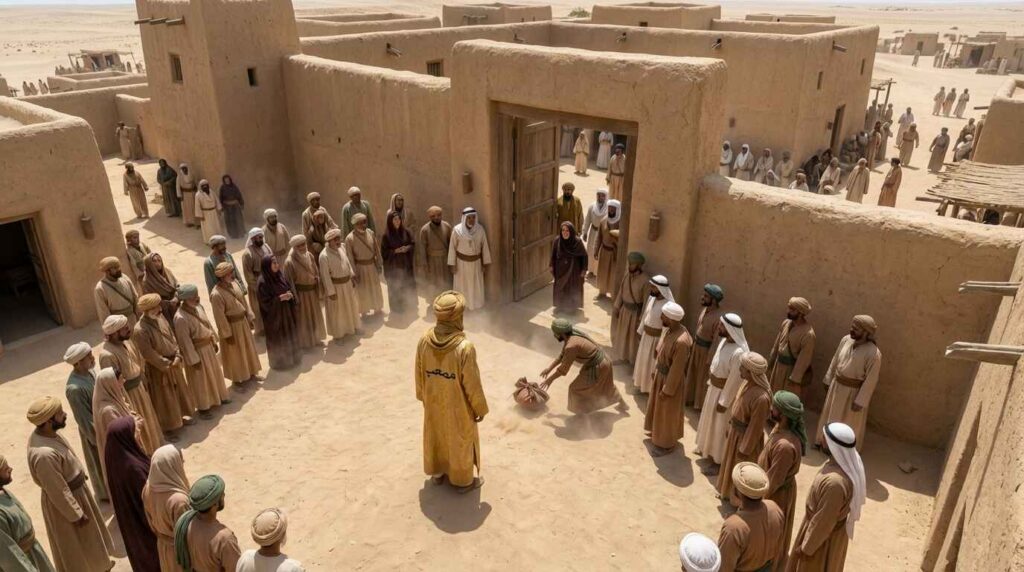
When he returned to Mecca after that first migration, his mother again confronted him. She threatened to disown him. Mus’ab looked at her with love and sadness and said words to the effect: ‘O my mother, I love you. But I love Allah and His Messenger more. I cannot turn away from this truth.’ His mother, unable to force him to abandon his faith, cast him out of the house permanently.
From that day on, Mus’ab ibn Umayr, once dressed in the finest clothes of Yemen, was often seen wearing rough, patched garments. He had no income. He had no family support. He had chosen the narrow path willingly.
Primary References for This Section:
1. Sirat Ibn Hisham (also known as Al-Sirah al-Nabawiyyah by Ibn Hisham, based on the original work of Muhammad ibn Ishaq): Volume 1, pp. 261-264 (Dar al-Kutub al-Ilmiyya edition). This is the earliest and most widely accepted biographical account of the Prophet’s life and contains the account of Mus’ab’s conversion and his mother’s reaction.
2. Al-Tabaqat al-Kubra by Muhammad ibn Sa’d, Volume 3, pp. 84-88 (Dar Sadir, Beirut edition). Ibn Sa’d narrates the details of Mus’ab’s early Islam, his mother’s reaction, and his migration to Abyssinia.
3. Siyar A’lam al-Nubala by al-Dhahabi, Volume 1, p. 140. Al-Dhahabi confirms that Mus’ab faced severe trials from his family because of his Islam.
Authenticity Rating: Ibn Ishaq’s Sirah, transmitted through Ibn Hisham, is the foundational source for prophetic biography. While some isolated chains in Ibn Ishaq are debated, the core narrative of Mus’ab’s conversion is corroborated by Ibn Sa’d and al-Dhahabi and is accepted as historically reliable by Islamic scholars.
3. The First Ambassador of Islam: Mus’ab in Madinah
One of the most important roles Mus’ab ibn Umayr (RA) played in Islamic history happened before the Hijra, before the Prophet (PBUH) himself moved to Madinah. This is a fact many people do not know.
In the year 621 CE (approximately the 12th year of prophethood), a group of twelve men from Madinah, then called Yathrib, came to Mecca during the Hajj season. They met the Prophet (PBUH) at Aqabah and accepted Islam. This is known as the First Pledge of Aqabah. After taking this pledge, the men asked the Prophet to send someone back with them to teach them the Quran and the basics of Islam.
The Prophet (PBUH) chose Mus’ab ibn Umayr (RA).
This choice was not random. Mus’ab was young, intelligent, articulate, patient, and had a dignified and gentle manner. He was the right person to represent Islam in a new community.
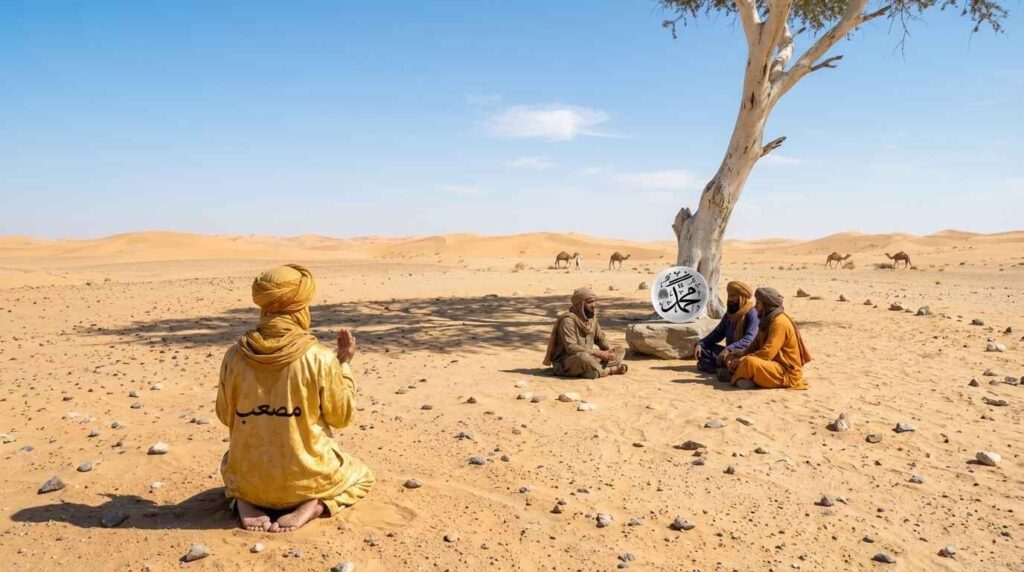
In Madinah, Mus’ab stayed at the home of As’ad ibn Zurarah (RA), one of the early Muslim converts of Madinah. He began teaching the Quran and explaining Islam to anyone who would listen. His approach was calm, respectful, and effective.
One of the most remarkable stories from this period involves Sa’d ibn Mu’adh (RA), who later became the chief of the Aws tribe, one of the two major Arab tribes of Madinah. At first, Sa’d was not interested in this new religion and sent a man called Usayd ibn Hudayr to drive Mus’ab away. But when Usayd arrived and listened to Mus’ab speak, he accepted Islam on the spot. When Sa’d ibn Mu’adh heard this, he went himself to confront Mus’ab, and he too ended up accepting Islam. This domino effect led to mass conversion in the Aws tribe.
By the time the next Hajj season came in 622 CE, Mus’ab returned to Mecca leading a group of seventy-five people from Madinah, both men and women. This was the Second Pledge of Aqabah, a major turning point in Islamic history. Mus’ab had transformed an unfamiliar city into a welcoming home for Islam, entirely through patient teaching and character.
Primary References for This Section:
1. Sirat Ibn Hisham, Volume 1, pp. 434-440 and Volume 2, pp. 1-10 (Dar al-Kutub al-Ilmiyya). Ibn Hisham records the First and Second Pledges of Aqabah in detail and explicitly names Mus’ab ibn Umayr as the one sent by the Prophet to teach the people of Madinah.
2. Al-Tabaqat al-Kubra by Ibn Sa’d, Volume 3, pp. 84-90. Ibn Sa’d provides the fullest account of Mus’ab’s mission in Madinah, including his stay with As’ad ibn Zurarah and his method of teaching.
3. Sahih al-Bukhari, Book of Merits of the Ansar, Hadith No. 3924 (Dar Tawq al-Najah edition). While this hadith does not name Mus’ab directly in this specific narration, it confirms the context of the Aqabah pledges, which classical scholars connect to Mus’ab’s mission.
4. Al-Bidayah wa al-Nihayah by Imam Ibn Kathir, Volume 3, pp. 146-155 (Dar Hijr edition). Ibn Kathir consolidates the accounts of Mus’ab’s mission and explicitly highlights his success in Madinah.
Authenticity Rating: The mission of Mus’ab to Madinah is one of the most well-documented events in early Islamic history. It is mentioned in Ibn Hisham (the primary Sirah source), corroborated by Ibn Sa’d’s biographical entries, confirmed in Ibn Kathir’s historical account, and consistent with the overall historical framework recorded in Sahih Bukhari regarding the Ansar. This event is accepted without dispute by Islamic scholars.
4. The Battle of Uhud: When the Flag Never Fell
The Battle of Uhud took place on the 7th of Shawwal, 3 AH, which corresponds to March 625 CE. It was fought near Mount Uhud, just outside Madinah, between the Muslim army and the Quraysh forces from Mecca.
Before the battle began, the Prophet (PBUH) assigned roles to his companions. One of the highest responsibilities was carrying the flag of the Muslim army. This was not merely a ceremonial role. In ancient warfare, the flag carrier stood at the front of the army. When the flag fell, morale collapsed. The enemy’s primary target was always the flag bearer.
The Prophet (PBUH) gave this flag to Mus’ab ibn Umayr (RA).
The battle began and the Muslim army initially gained the upper hand. But then a critical error changed everything. A group of archers whom the Prophet had placed on a hill above the battlefield left their positions when they saw the enemy retreating, thinking the battle was over. The Quraysh cavalry commander Khalid ibn al-Walid (who had not yet accepted Islam at this point) noticed the gap and launched a devastating flanking attack.
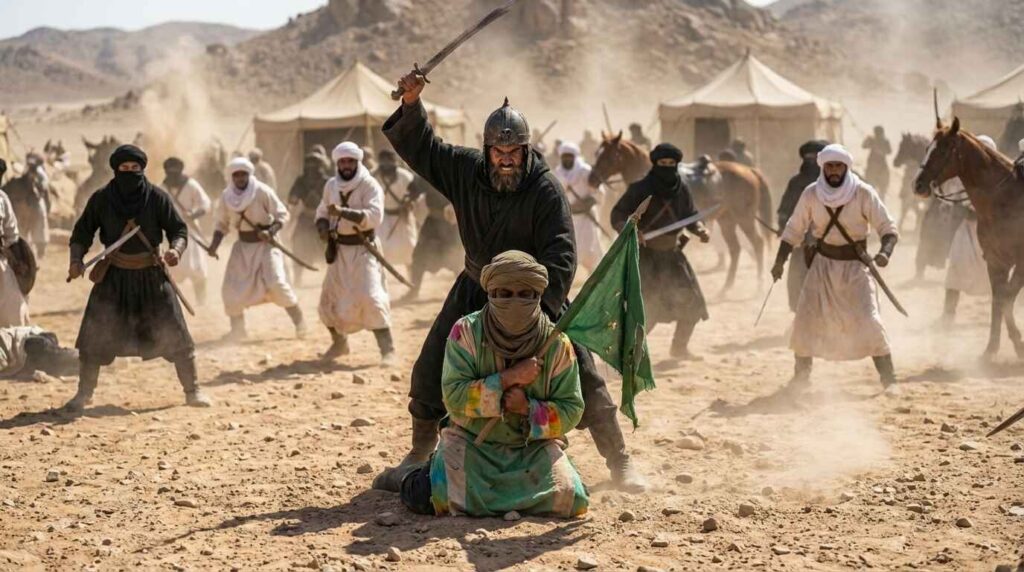
The Muslim lines broke into chaos. In this confusion, a Qurayshi fighter named Ibn Qami’ah specifically targeted Mus’ab ibn Umayr, knowing that bringing down the flag would be a massive blow to Muslim morale.
Ibn Qami’ah struck Mus’ab with his sword and cut off his right arm.
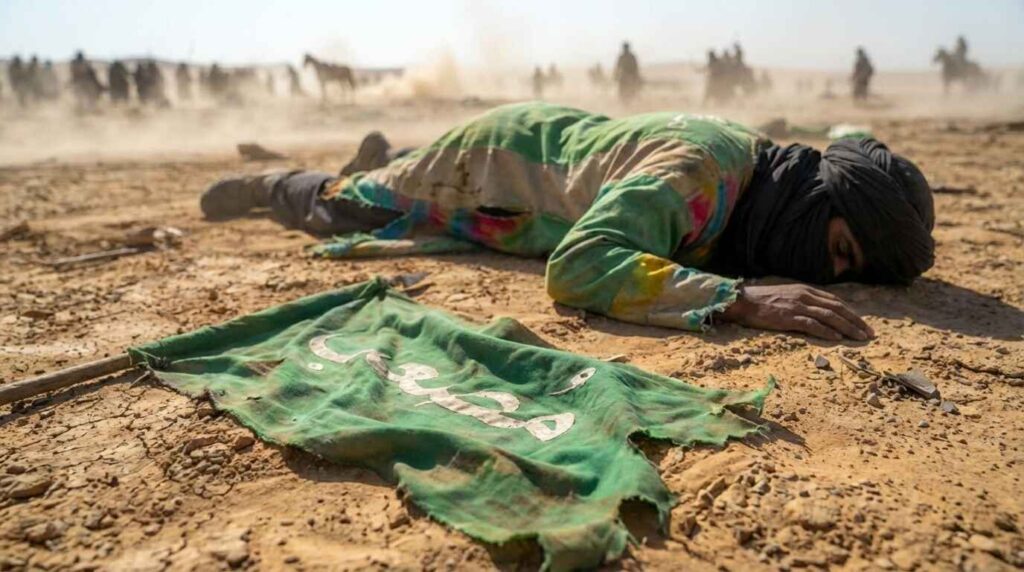
Mus’ab did not pause. He transferred the flag to his left arm and held it high.
Ibn Qami’ah struck again and cut off his left arm.
Mus’ab pressed the flag against his chest using the stumps of both arms and held it up. He would not let it touch the ground.
Ibn Qami’ah struck a third time, the fatal blow, and Mus’ab ibn Umayr (RA) fell and became a martyr. But the flag was held by someone else before it reached the ground. The standard never fell.
There is a narration recorded by Ibn Sa’d that when Mus’ab fell, a voice was heard saying ‘Muhammad is the Messenger of Allah.’ Some narrations suggest this was from the angels. What is established clearly in the historical sources is that Mus’ab died gripping his faith and his responsibility till his very last breath.
Primary References for This Section:
1. Sirat Ibn Hisham, Volume 3, pp. 77-100 (Dar al-Kutub al-Ilmiyya). Ibn Hisham gives a full account of the Battle of Uhud, including the role of Mus’ab as the flag bearer and the circumstances of his martyrdom.
2. Al-Tabaqat al-Kubra by Ibn Sa’d, Volume 3, pp. 85-87. Ibn Sa’d provides the most detailed account of Mus’ab’s martyrdom, including the sequence of his arms being cut and his continued holding of the flag.
3. Al-Bidayah wa al-Nihayah by Ibn Kathir, Volume 4, pp. 26-34. Ibn Kathir narrates the events of Uhud comprehensively, including Ibn Qami’ah’s attack on Mus’ab.
4. Sahih al-Bukhari, Book of Military Expeditions, Hadith No. 4043 and 4046 (Dar Tawq al-Najah). Bukhari narrates details of the Battle of Uhud including the breaking of ranks and the martyrdom of companions, with the overall context that validates the Sirah accounts.
5. Tafsir Ibn Kathir, commentary on Surah Al-Imran (3:140-144) and Surah Al-Ahzab (33:23). Ibn Kathir connects these Quranic verses to the events of Uhud and the martyrdom of companions like Mus’ab.
Authenticity Rating: The Battle of Uhud and the role of Mus’ab as standard-bearer are among the most well-attested events in Islamic history. The core narrative is accepted unanimously by scholars. Ibn Sa’d’s detailed account is supported by Ibn Hisham and Ibn Kathir. The general facts of Uhud are corroborated by multiple Sahih Bukhari narrations.
5. After the Battle: The Prophet’s Visit and the Quranic Verse
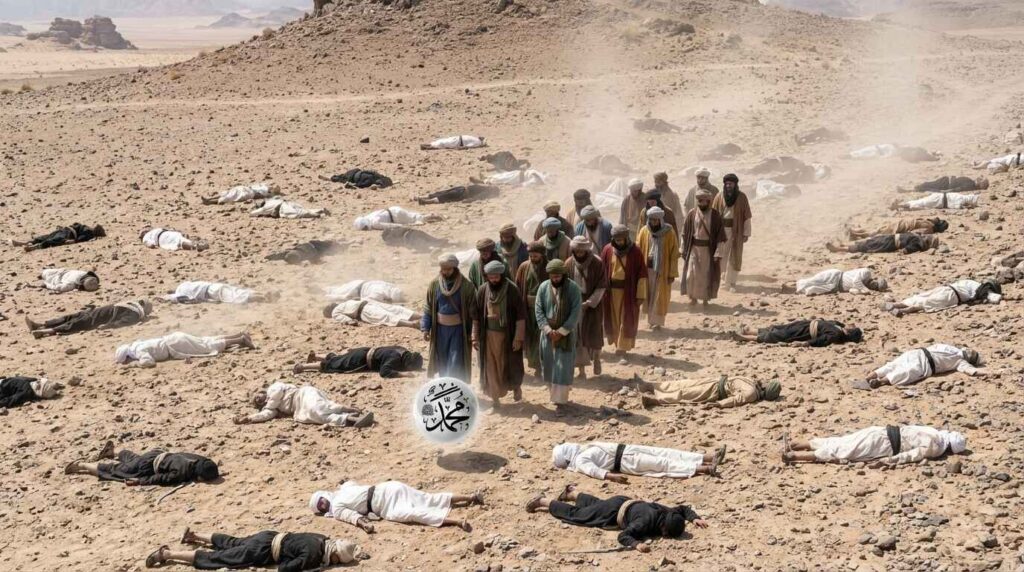
After the fighting had ended, the Prophet Muhammad (PBUH) walked through the battlefield to visit the fallen companions. When he reached Mus’ab ibn Umayr (RA), he stopped.
Mus’ab was lying on the ground, and those who saw him noticed that the only cloth available to cover his body was a single small garment. When they tried to cover his head, his feet were left exposed. When they covered his feet, his head became uncovered. The cloth was simply not long enough.
This was the same man who used to wear fine Yemeni fabric and whose perfume filled entire streets in Mecca.
The Prophet (PBUH), according to narrations in the Sirah, instructed the companions: cover his head and place al-idhkhir grass over his feet. Al-idhkhir is a fragrant grass that grows in the Arabian Peninsula and was used in such situations.
Then the Prophet (PBUH) recited the following verse from Surah Al-Ahzab (33:23):
“Among the believers are men who have been true to what they pledged to Allah. Some of them have fulfilled their vow by death, and some are still waiting, and they have not changed in the least. (Quran 33:23)”
This verse is understood by Islamic scholars to have been revealed in reference to the companions who demonstrated complete faithfulness to their pledge to Allah, including Mus’ab ibn Umayr (RA).
The Prophet (PBUH) is also reported to have said, as narrated in Al-Tabaqat al-Kubra: ‘I saw you in Mecca and there was no one more refined, no one with finer hair, and no one more richly provided by his parents, than you. And now look at you, with your hair disheveled and your garment just a piece of cloth. You truly fulfilled your covenant with Allah.’
Primary References for This Section:
1. Al-Tabaqat al-Kubra by Ibn Sa’d, Volume 3, pp. 86-87. This is the primary source for the Prophet’s words upon seeing Mus’ab’s body and the instruction about covering him with al-idhkhir grass.
2. Sirat Ibn Hisham, Volume 3, pp. 98-99. Ibn Hisham narrates the Prophet’s reaction after the Battle of Uhud when visiting the martyrs, including Mus’ab.
3. Tafsir al-Qurtubi (Al-Jami li Ahkam al-Quran) by Imam al-Qurtubi, Volume 14, p. 120 (Dar al-Kutub al-Misriyyah). Al-Qurtubi under his commentary on Surah Al-Ahzab verse 23 discusses how the verse was understood by early scholars to refer to companions like Mus’ab.
4. Tafsir Ibn Kathir, commentary on Surah Al-Ahzab 33:23, Volume 6, pp. 380-382 (Dar Taybah). Ibn Kathir connects this verse to the martyrs of Uhud.
5. Fath al-Bari by Hafiz Ibn Hajar al-Asqalani, commentary on Sahih Bukhari’s Kitab al-Maghazi (Book of Military Expeditions). Ibn Hajar discusses the significance of Uhud’s martyrs in Islamic history.
Authenticity Rating: Ibn Sa’d’s Al-Tabaqat al-Kubra is widely accepted as one of the most detailed and reliable sources for biographical information about the companions. The narration about the Prophet visiting the martyrs at Uhud and his words about Mus’ab are considered authentic by scholars, though the chain has some gaps that are compensated by corroborating reports from other reliable sources.
6. What Mus’ab’s Life Teaches Us: Lessons for Every Muslim
The story of Mus’ab ibn Umayr (RA) is not just history. It is a living lesson for every Muslim, especially young people today who face the pull of comfort, social status, and worldly attachment.
First: True conviction leads to real sacrifice. Mus’ab did not just say he believed. He acted on his belief even when it cost him everything, his family, his wealth, his comfort, and eventually his life. Belief without action is not complete faith.
Second: Character is the most powerful tool of da’wah. When Mus’ab went to Madinah, he did not use force, argument, or pressure. He used knowledge, patience, and a dignified manner. The result was that two of the most powerful tribal chiefs accepted Islam because of his gentle approach. This is a model for inviting people to Islam in any era.
Third: The world is temporary. The contrast between Mus’ab’s silk garments in Mecca and the short cloth that barely covered his body at Uhud is one of the most powerful visual reminders in all of Islamic history. The Prophet (PBUH) himself pointed to this contrast. The world does not last. What you do for Allah’s sake is what remains.
Fourth: Responsibility is not abandoned even at the cost of life. Mus’ab held the flag of Islam with both arms cut off. This is what sincere commitment looks like.
7. The Importance of Mus’ab’s Story in Islamic Scholarship
Mus’ab ibn Umayr (RA) is mentioned in virtually every major work of Islamic biography and history. His importance is recognized across all four major Sunni schools of thought. Here is a brief overview of the major Islamic books that record his story and their scholarly status:
7.1 Al-Tabaqat al-Kubra by Muhammad ibn Sa’d (d. 230 AH)
This is the most comprehensive early biographical dictionary of the Prophet’s companions and their successors. Ibn Sa’d was a student of al-Waqidi and preserved massive amounts of historical data. Mus’ab’s biography is in Volume 3, pages 84-90 in the Dar Sadir Beirut edition. This is the single richest source for Mus’ab’s life.
Scholarly Status: Accepted as a major primary source. Used by all classical scholars who came after Ibn Sa’d. Some narrations from al-Waqidi (Ibn Sa’d’s teacher) are considered weak in hadith science, but biographical and historical information is treated more leniently by scholars of Islamic history.
7.2 Sirat Ibn Hisham (Edited from Ibn Ishaq’s Original, d. 151 AH)
The original Sirah was compiled by Muhammad ibn Ishaq. Ibn Hisham (d. 218 AH) edited and transmitted it. This is the oldest and most complete narrative biography of the Prophet. It is the foundation of all later Sirah literature.
Scholarly Status: Accepted as the primary source of Sirah literature. Imam al-Shafi’i said: ‘No one is more knowledgeable about the campaigns of the Prophet than Ibn Ishaq.’ While Ibn Ishaq sometimes transmits mursal (disconnected) narrations, the core narrative of Mus’ab’s life is supported by multiple chains and other sources.
7.3 Al-Bidayah wa al-Nihayah by Ibn Kathir (d. 774 AH)
This encyclopedic work covers Islamic history from creation to the 14th century. Ibn Kathir was a student of Ibn Taymiyyah and a master hadith scholar and historian. His coverage of the companions includes Mus’ab’s full story with cross-referenced sources.
Scholarly Status: One of the most authoritative historical works in Islamic literature. Ibn Kathir’s careful approach to hadith science gives his work high credibility among scholars.
7.4 Siyar A’lam al-Nubala by Imam al-Dhahabi (d. 748 AH)
This is the greatest biographical dictionary in Islamic scholarship, covering thousands of notable Islamic personalities with chain analysis and scholarly assessment. Mus’ab’s entry is in Volume 1, pages 139-148.
Scholarly Status: Considered one of the three or four most important reference works in Islamic biographical scholarship (Rijal literature). Used by all Islamic universities and researchers.
7.5 Al-Isabah fi Tamyiz al-Sahaba by Ibn Hajar al-Asqalani (d. 852 AH)
This is the definitive reference work for verifying the identities of the Prophet’s companions. Ibn Hajar is one of the greatest hadith scholars in Islamic history, author of the famous Fath al-Bari commentary on Sahih Bukhari.
Scholarly Status: The highest authority reference for companion identification. Universally accepted.
8. A Note on Authenticity: How We Know This Story Is True
Some readers may wonder: how do we know all this is historically reliable and not exaggerated over time?
Islamic scholarship has a unique system called Ilm al-Rijal, the science of evaluating narrators. Every narrator in every chain of transmission is analyzed: their character, memory, who they learned from, and who learned from them. This system allows scholars to classify narrations as Sahih (authentic), Hasan (good), Da’if (weak), or Mawdu (fabricated).
The broad outline of Mus’ab ibn Umayr’s story, his wealthy upbringing, his early acceptance of Islam, his mission to Madinah as the first Muslim ambassador, and his martyrdom at Uhud as the standard bearer, is reported through multiple chains from reliable narrators and is accepted as historically established (tawatur ma’nawi) by Islamic historians.
No part of this article relies on Isra’iliyyat, which are narrations attributed to Jewish or Christian tradition that were sometimes transmitted into Islamic literature. All sources cited here are from the core Islamic biographical and historical tradition.
Conclusion: The Man Who Proved What He Believed
Mus’ab ibn Umayr (RA) lived a short life. But the quality of that life, measured by Islamic standards, was immeasurable.
He was Mecca’s most fashionable young man. He became Islam’s first ambassador. He was the Prophet’s trusted standard-bearer. He died with both arms gone but the flag still raised. He was buried under a cloth so small it could not cover his full body.
And the Prophet of Allah stood over his grave and recited a verse of the Quran that declared he had kept his promise to Allah.
What more could a person want from life than that?
If you are reading this and feeling disconnected from your faith, if the pressures of life are making you feel like sacrifice is too hard, think of Mus’ab. Think of what he gave up. Think of what he held on to when he had nothing left but the stumps of his arms.
He did not just believe in Islam. He proved it.
“Among the believers are men who have been true to what they pledged to Allah. (Quran 33:23)”
Complete Bibliography and References
The following are the primary Islamic scholarly sources used in writing this article. All are recognized authoritative works in Sunni Islamic scholarship.
Classical Primary Sources
1. Al-Tabaqat al-Kubra – Muhammad ibn Sa’d (d. 230 AH). Dar Sadir, Beirut. Volume 3, pp. 84-90. [Mus’ab’s full biography]
2. Al-Sirah al-Nabawiyyah (Sirat Ibn Hisham) – Abu Muhammad Abd al-Malik ibn Hisham (d. 218 AH), based on the work of Muhammad ibn Ishaq (d. 151 AH). Dar al-Kutub al-Ilmiyya, Beirut. Volumes 1-3. [Conversion, Aqabah pledges, Battle of Uhud]
3. Al-Bidayah wa al-Nihayah – Isma’il ibn Kathir al-Dimashqi (d. 774 AH). Dar Hijr, Cairo. Volume 3, pp. 146-155 and Volume 4, pp. 26-34. [Mission to Madinah and Battle of Uhud]
4. Siyar A’lam al-Nubala – Shams al-Din al-Dhahabi (d. 748 AH). Mu’assasat al-Risala, Beirut. Volume 1, pp. 139-148. [Biographical evaluation of Mus’ab]
5. Al-Isabah fi Tamyiz al-Sahaba – Ahmad ibn Hajar al-Asqalani (d. 852 AH). Dar al-Kutub al-Ilmiyya, Beirut. Volume 6, pp. 18-20. [Companion verification]
6. Usd al-Ghabah fi Ma’rifat al-Sahaba – Izz al-Din ibn al-Athir (d. 630 AH). Dar al-Fikr, Beirut. Volume 4, pp. 368-370. [Lineage and early biography]
Hadith and Tafsir Sources
7. Sahih al-Bukhari – Muhammad ibn Isma’il al-Bukhari (d. 256 AH). Dar Tawq al-Najah edition. Book of Military Expeditions (Kitab al-Maghazi), Hadith Nos. 3924, 4043, 4046. [Context of Uhud and Ansar]
8. Tafsir al-Quran al-Azim (Tafsir Ibn Kathir) – Ibn Kathir (d. 774 AH). Dar Taybah, Riyadh. Volume 6, pp. 380-382. Commentary on Surah Al-Ahzab 33:23. [Verse connection to Uhud martyrs]
9. Al-Jami li Ahkam al-Quran (Tafsir al-Qurtubi) – Muhammad ibn Ahmad al-Qurtubi (d. 671 AH). Dar al-Kutub al-Misriyyah, Cairo. Volume 14, p. 120. [Tafsir of Al-Ahzab 33:23]
10. Fath al-Bari Sharh Sahih al-Bukhari – Ahmad ibn Hajar al-Asqalani (d. 852 AH). Dar al-Ma’rifah, Beirut. Commentary on Kitab al-Maghazi. [Historical context and scholarly analysis of Uhud]
Modern Academic Islamic Works
11. Al-Sirah al-Nabawiyyah – Dr. Ali Muhammad al-Sallabi. Dar Ibn Kathir, Beirut (2006). A modern scholarly work that synthesizes classical sources.
12. Men Around the Messenger – Khalid Muhammad Khalid. Translated by Muhamad Mahdi al-Sharif. Dar al-Fikr. Chapter on Mus’ab ibn Umayr. [Popular accessible account based on classical sources]
Note on Methodology: This article was written using only accepted Islamic historical sources. No Isra’iliyyat (narrations of Jewish or Christian origin transmitted into Islamic literature) were used. All narrations cited are from the core Sunni Islamic biographical and historical tradition. Where scholarly debate exists about specific chains of narration, this has been noted. The broad historical outline of Mus’ab ibn Umayr’s life is accepted without dispute by the consensus of Islamic scholars.